
How to Search Criminal Dockets
Vernon County sits inside Missouri's unified circuit-court system. Its Circuit Court handles local criminal matters. For a docket search, the public starting point is Missouri Case.net. You can hunt by litigant name or case number. That pulls up a Vernon criminal docket. When you just need a court date, the scheduled-hearing lane works best. If several results look alike, compare the court, county, division, case type, and the full case number shown on screen. Do not try to recall a short number prefix from memory.
A case number beats everything. Names fail when someone appears in a file as a victim, witness, child, or protected participant. That person is not an indexed litigant. A missing name result does not prove the case is absent. The Circuit Clerk can point you to the right administrative records route. Clerk staff cannot give legal advice or explain what a case event means for you.
- Open Missouri Case.net and select Litigant Name Search or Case Number Search. Use the Vernon County or circuit context when the live search asks for it.
- Enter the full name or complete number from a citation, notice, pleading, or court correspondence. Review the result rows before choosing a match.
- Select the returned case number to open Case Header. Confirm the court, county, division, case type, status, and filing date.
- Read Docket Entries in date order. For a date question, compare Scheduled Hearings & Trials with later entries for a continuance, appearance, plea, judgment, or correction.
- When a public attachment is not visible, use the courthouse public-access terminal or make a written COR 2.08 copy request to the Circuit Clerk.
Note: a scheduled hearing on a docket is only a plan. A later entry must confirm the event before you treat it as one that happened.
Searching Vernon County Criminal Cases Through Case.net
Case.net gives the public four lanes. These are litigant name, filing date, case number, and Scheduled Hearings & Trials. The filing-date lane helps when the name is fuzzy. It works when the rough filing window is known. Remember, the result list is just an index. It is not a promise of a complete file. Once a case number opens, start with Case Header, then work through the chronology. From an opened case, the Track This Case icon may be available. The official public guide bars tracking for any case flagged with a red Fine Collection Center message.
| Case.net lane | Useful Vernon criminal-docket use |
|---|---|
| Litigant Name Search | Start with a reliable last and first name, while recognizing protected names may not be indexed. |
| Filing Date Search | Narrow a time period when the approximate filing window is known. |
| Case Number Search | Use the complete identifier from a court document, summons, or citation for the most direct match. |
| Scheduled Hearings & Trials | Locate a listed setting, then return to the docket to check later entries. |
What a Criminal Docket Shows
Open a public criminal view and you may see the case number, court or division, filing date, case type, status, party and attorney roles, charge or count details, and events in order. Entries may cover a summons, warrant, arraignment, plea, motion, trial, sentencing, judgment, or a financial item when public. Read each line as written. A charge is not a final outcome. A future setting has not happened yet.
The Court Operating Rule 4 materials set out statewide automation, public-access equipment, and the limits that apply to court information.
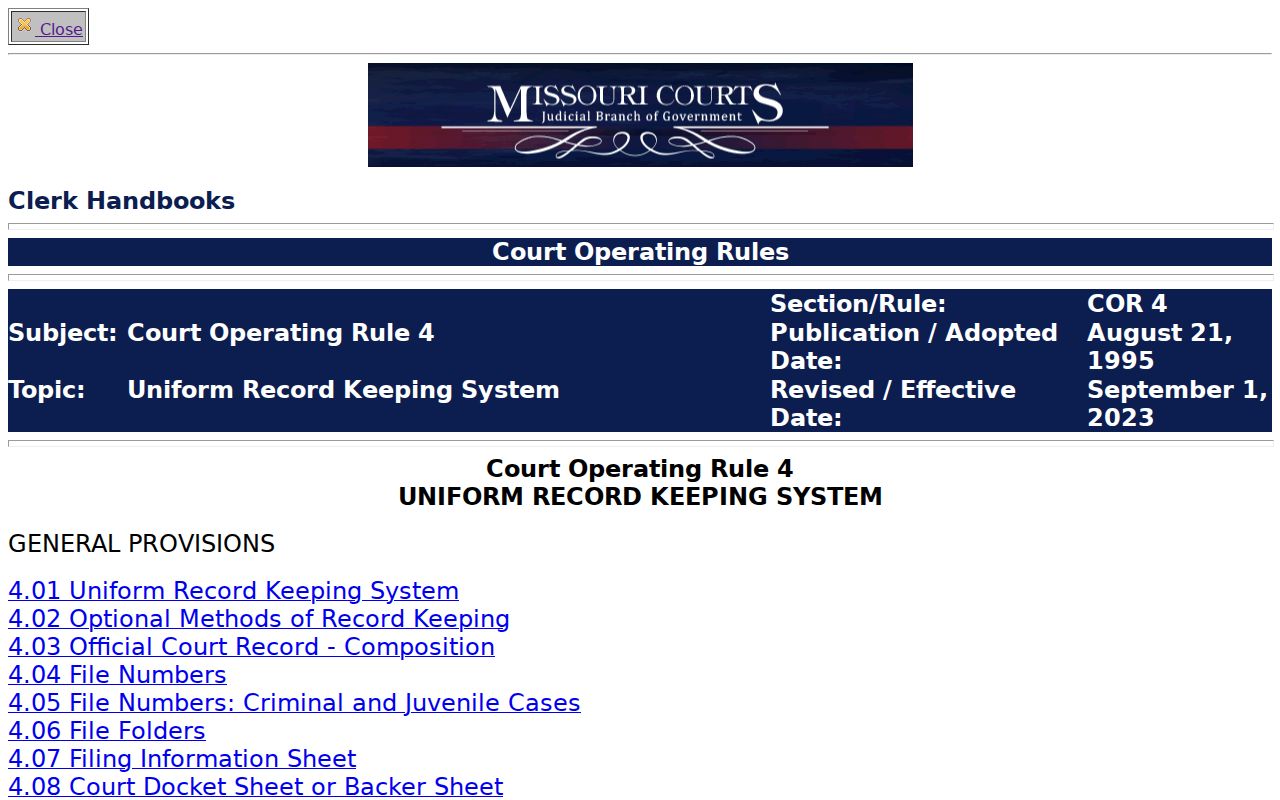
For a Vernon criminal docket, that rule explains a key gap: an open index and a public document image are two different things.
| Case Header | Opening case-information view after selecting a result, with the public case number, style, court, and status. |
|---|---|
| Case number | Use the exact number Case.net displays; no local shorthand expansion was established in the research. |
| Charges and counts | Public charge or ordinance wording and a statute reference may appear, but they are not a disposition. |
| Docket Entries | Chronological filings, settings, motions, orders, pleas, judgments, or related events where public. |
| Scheduled Hearings & Trials | Date, time, setting type, judge or courtroom when shown, subject to later continuance or cancellation entries. |
| Documents | A linked entry can indicate an attached public document; an unlinked entry may have no attachment or restricted access. |
Vernon County Criminal Docket Fields and ECASE
Case Header and Docket Entries answer different questions. The header confirms a result belongs to the right Vernon court and case lane. The docket then shows when events happened and in what order. In the File Viewer, a blue case-number or style bar marks the case. The tag (ECASE) means the record is electronic. There is no paper file behind it. Still, remote access to every filing or attachment is not guaranteed.
- Docket Entry
- A chronological record of a filing, order, setting, disposition, or other court event.
- Document link
- A docket-entry hyperlink that may open an attached public document.
- Disposition
- The recorded resolution or status of a case or count, when one is entered.
- Scheduled Hearing
- A future or historical calendar setting that requires a docket check for what later happened.
Access turns on document category, security, and record type. A line without a hyperlink can mean no attachment exists, or that the viewer simply cannot have it. When an event shows but its attachment does not, use the courthouse terminal or the local written-copy procedure.
Stages on a Criminal Docket
Docket entries in a criminal case record procedure over time. The exact order varies. A Vernon case may show the filing, arraignment, pretrial settings, a plea or trial setting, a disposition, and sentencing or judgment entries. That is the spine of the case. Between those points come motions, continuances, warrants, bond entries, and later corrections. Reading only the first charge line skips the story of how the matter actually changed.
Docket flow: Filing › Arraignment › Pretrial › Plea or Trial › Disposition › Sentencing
A closed or disposed status does not make every item public. Look to the docket language for the disposition or judgment itself. Until a later entry shows a result, treat a scheduled setting as nothing more than a schedule.
Vernon County Criminal Docket Warrant Entries
A warrant entry is a docket event, nothing more. It is not proof of service or current status. Check the entry's date and wording, then scan later Vernon County criminal docket entries for an appearance, withdrawal, disposition, or other update. The public record lets you report what the screen displays, not conclusions beyond it.
Vernon County Criminal Docket: Charge and Disposition
Don't mistake a charge title for a verdict. On a Vernon County criminal docket, a charge is only an allegation. It stays that way until the record shows a disposition or judgment. Warrants deserve the same caution. A warrant entry proves the warrant existed, not that it was served or still stands. Stick to neutral docket words like filed, scheduled, continued, entered, disposed, and judgment. Those match what the record actually supports.
A listed date is just a setting, not a result. Open the full case and look for a later continuance, cancellation, appearance, order, disposition, or judgment. Do this before you assume anything happened. That habit keeps an old historical entry from being read as a current instruction.
Vernon County Criminal FY14 Snapshot
The FY14 judicial supplement is a historical yardstick, nothing more. It won't tell you today's caseload. Its Vernon tables counted felony, associate-felony, misdemeanor, traffic, and ordinance work. That mix holds a practical lesson. Start any criminal docket search with the court, division, case type, and full case number on the result. Not every criminal docket in Vernon County is a felony docket.
The report counted 397 associate-felony filings in Vernon that year, plus two ordinance filings, along with year-end pending counts. Those numbers describe FY14 alone. They say nothing about current volume, delay, or how any single docket ends.
Which Court Holds Criminal Dockets
Criminal dockets live in the Circuit Court of Vernon County. That court sits in the Missouri Circuit Court, 28th Judicial Circuit. Missouri runs one unified circuit-court structure. Felony, associate-circuit felony, misdemeanor, traffic-related, and ordinance-related matters exist. They can sit in different divisions or case-number families. The county forms no separate court systems for them. For records and filing, the Vernon Circuit Clerk is the local contact. The county lists the case lanes the clerk covers.
Municipal divisions count as circuit-court divisions too. Nevada's official materials name a Nevada Municipal Division of the 28th Judicial Circuit. For other Vernon cities, confirm the route with the city or the Circuit Clerk. Don't hunt for a municipal portal. A city matter needs the city name plus the citation or case number. Search Case.net, then verify. A federal case belongs in PACER/CM/ECF, not the Vernon criminal docket.
Vernon County Criminal Docket Protected Names
A name search can come up empty even when a case exists. Try the full case number from a citation, order, or clerk correspondence. The docket index may skip some names. A Vernon County criminal docket may not index a protection-order subject, victim, witness, or child by name. Don't try to rebuild protected names from outside sources. Leave confidential records alone too.
Public Access and Sealed Criminal Dockets
Missouri's public court index is useful, but it is no open file room. Court Operating Rule 4 runs the statewide automation and public-access equipment. It keeps confidential records out of automated public search. Juvenile records carry separate statutory protections. Sealed, expunged, or closed records have their own access limits. So a missing name, redacted detail, or unavailable document can reflect those limits. It may not be a failed search.
The official Missouri Rule 122 materials set out the juvenile and family record-access exceptions that apply to protected case categories.
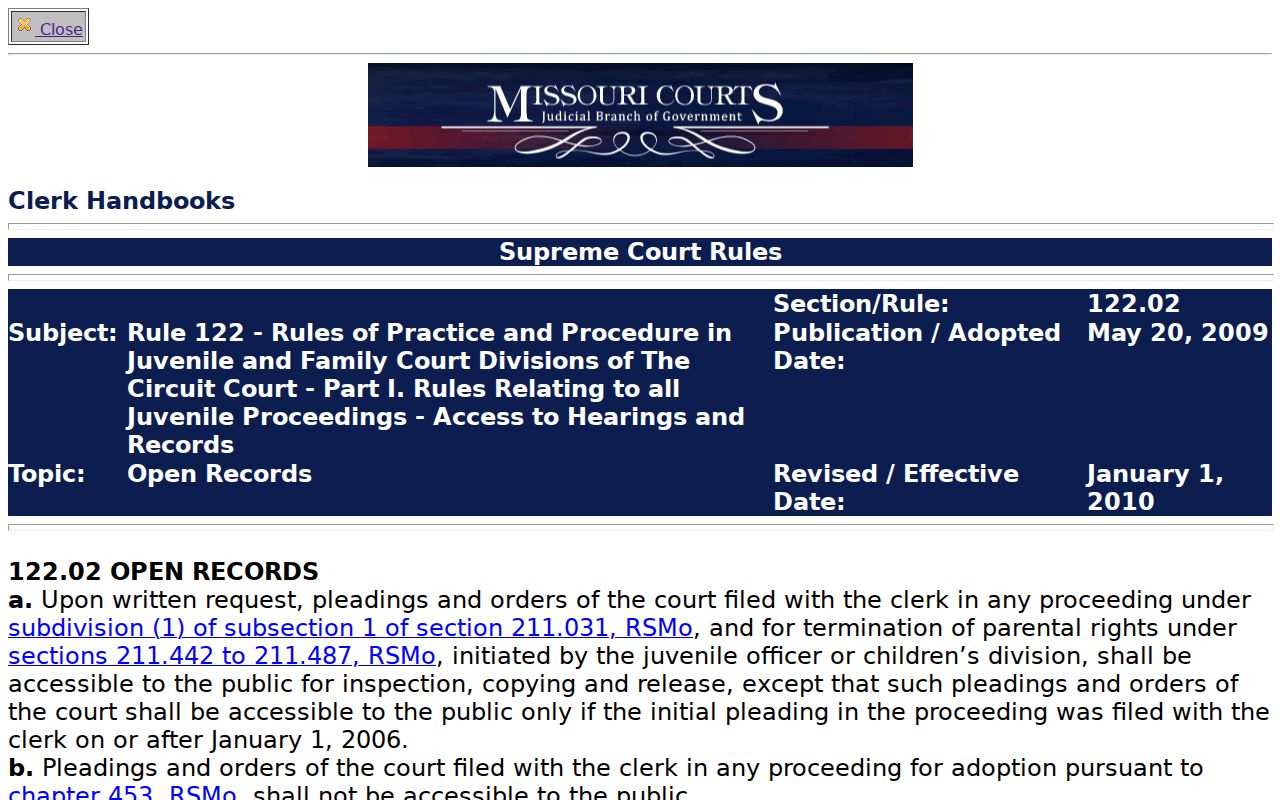
That protection explains plenty. A public criminal index may omit names, documents, or settings that seem tied to a case.
Access boundaries:
RSMo §211.321 protects juvenile court records subject to statutory exceptions.
RSMo §610.120 makes closed records inaccessible to the general public except as authorized.
RSMo §610.140 governs expungement procedure and related confidentiality.
Vernon County Criminal Docket Routing Contacts
The Circuit Clerk stays the public docket and copy-request contact. The county court page also lists probation or parole at 417-448-1250 and the public defender at 417-448-1140. Either number can route the right party. Neither office replaces the Vernon County criminal docket. Neither gives legal advice to an unrelated requester.
Requesting a Vernon County Criminal Docket Attachment
When a public docket event shows no attachment, first check whether the entry is linked. Also check for an ECASE flag or a security notice. Public users can work from the courthouse public-access terminal for statewide public cases and documents where remote access doesn't expose a file. For copies, Vernon follows the county's COR 2.08 written procedure; there is no online request form.
A written request can go by mail, fax, email, or hand delivery. Include the case number if known, party names, and case type. Add the filing date or an approximate one. Also list the exact documents you want. The Circuit Clerk's office sits at 100 W. Cherry St., Suite 15, Nevada, MO 64772; call 417-448-2525 or fax 417-448-2512. Copies run $0.20 per page. An advance deposit may be required. No fixed turnaround is promised.
The official RSMo §610.120 record-access text is the primary source on closed-record restrictions that can limit what the Circuit Clerk may provide.
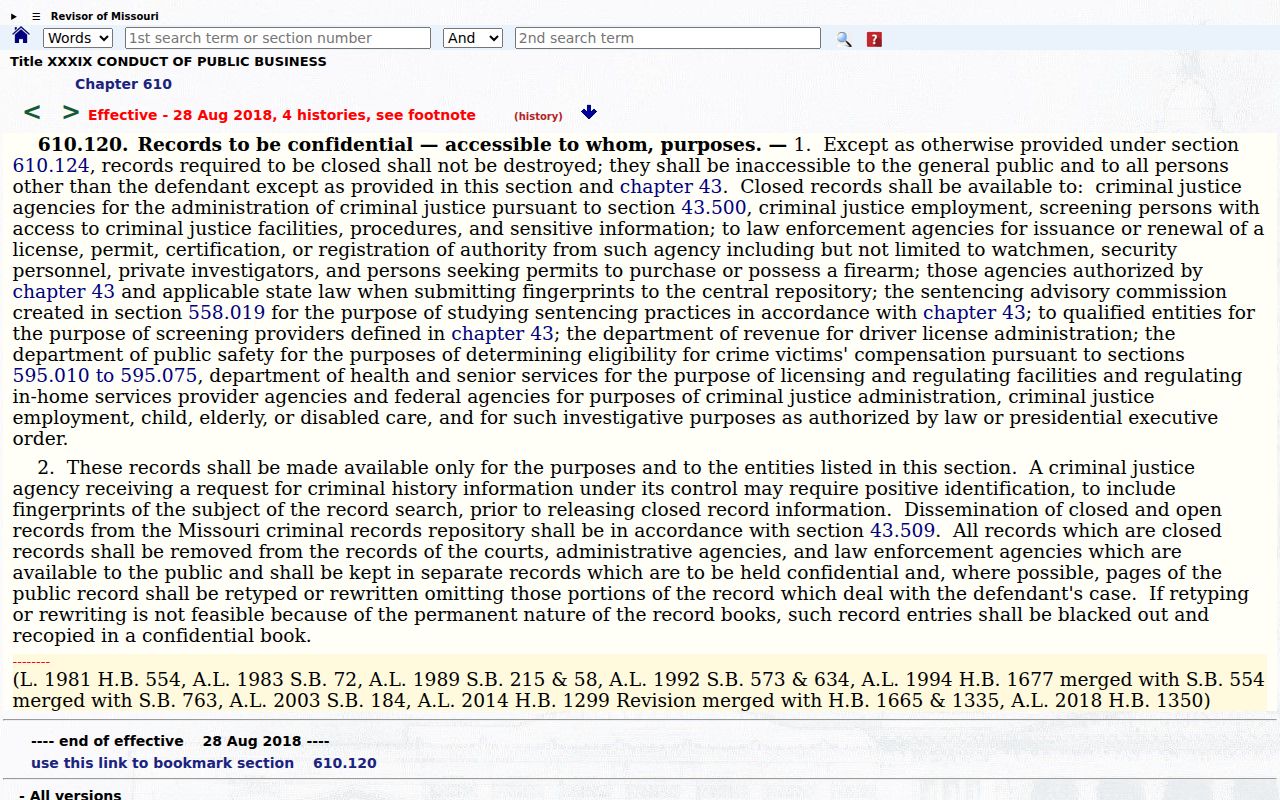
For a public attachment, a specific written request gives the clerk what's needed to apply the right access and redaction rules.
Note: Under the county procedure, a party seeking an unredacted copy must show a driver's license or photo ID.